

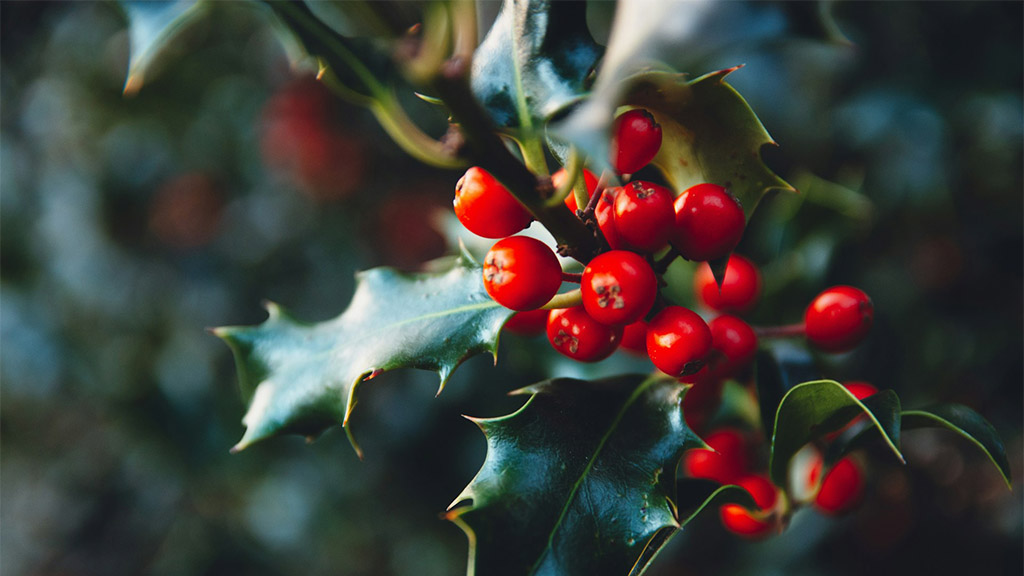
The tradition of bringing greenery indoors during the winter is a nearly universal human custom, rooted in ancient observations of the longest night of the year, the Winter Solstice. This practice is fundamentally botanical history: an act of sympathetic magic where hardy plants become powerful symbols of life’s promised return, transcending specific faith traditions. Many cultures around the world celebrate the Winter Solstice using plants with important symbolic meaning.
The Northern European Tradition: Yule and the Evergreens
In ancient Northern Europe, the festival of Yule (or Jól, as it was originally referred to in Old Norse) centered on the perpetual struggle between light and dark. The plants chosen as part of this celebration were revered for their tenacity in the face of deep cold.
- Holly: With its glossy, prickly leaves and fire-red berries, Holly symbolized the Holly King, the ruler of the contracting, darker half of the year. The plant’s berries were a crucial sign of life, symbolizing warmth and blood surviving the freeze.
- Ivy: Often woven with Holly, Ivy’s strong, clinging growth represented eternal life, fidelity, and the perpetual cycle of the seasons.
- The Yule Log: Traditionally a piece of Oak, it was burned to honor the Oak King (the ruler of the waxing, lighter half of the year), and its fire was intended to physically encourage the sun’s return.
The Fir or Pine Tree embodied the Norse concept of the World Tree (Yggdrasil), representing the cosmos’s enduring vitality. Bringing an evergreen bough into the home was an act of purification and reverence, recognizing that life persists even in the dormant months.
Global Botanical Defiance
This botanical response to winter is not exclusive to Europe. Other cultures adapted plants and fruits to their own seasonal rituals:
- The ancient Persian festival of Shab-e Yalda (Night of Birth) honors the seasonal transition with the brilliant red Pomegranate and Watermelon. The intense red color of these fruits symbolizes the crimson dawn and the birth of light after the longest night.
- The Chinese Dongzhi Festival utilizes warming root vegetables and herbs like ginger to balance the body’s internal Yang (warmth) against the external Yin (cold), connecting health directly to the earth’s yield.
Northern Adaptation: The Minnesota Connection
In the harsh reality of the Minnesota winter, these symbols take on a profoundly local meaning. While English Holly cannot survive here, our native Winterberry (Ilex verticillata) stands in its place, its bright red berries on bare branches offering a stunning, hardy tribute to the Holly King. Similarly, our majestic Bur Oaks often hold their brown leaves through the snow, standing as stoic sentinels of the Oak King’s dormant strength. Our native Red Pine (Pinus resinosa), the state tree, and the fragrant Balsam Fir (Abies balsamea) are the literal embodiments of life defying Zone 4 temperatures.
These days, many of our Minnesotan winter traditions align ancient seasonal practices with modern ecological choices. For example, many gardeners use locally sourced, salvaged boughs from pruning operations, purchase fully containerized living trees for planting after the holiday, or opt for durable, high-quality artificial evergreens. The core symbolism remains the same: celebrating resilience without requiring the felling of a whole tree.
The use of these evergreens in our modern celebrations connects the universal Solstice theme of renewal to our specific, resilient landscape. When we bring locally sourced pine or fir indoors, we are participating in a tradition thousands of years old—a silent, botanical acknowledgement that the darkness is temporary and the spring is inevitable.
References
Ancient & Northern European Folklore:
- Hutton, Ronald. The Stations of the Sun: A History of the Ritual Year in Britain. Oxford University Press, 1996. (A primary source for Holly, Ivy, and Mistletoe symbolism).
- Simek, Rudolf. Dictionary of Northern Mythology. D.S. Brewer, 1993. (For the World Tree/Yggdrasil connection).
East Asian & Persian Cultural History:
- Mahdavi, Pardis. “A Persian festival, Yalda, celebrates the triumph of light over darkness.” Religion News Service, 2021.
- Hopkins Medicine. “Dongzhi Festival.” (Resource used for cultural practices and food symbolism).
Horticulture and Minnesota Connection:
- University of Minnesota Extension. Choosing Evergreens for your Landscape. (Source for Red Pine and Balsam Fir hardiness).
- The Minnesota Department of Natural Resources (DNR). (Source for Red Pine as state tree).
By Matthew Stoffel
Photo by Anne Drotleff on Unsplash